October 27, 2026
Most of us are used to opening a separate AI chatbot when we need help writing, researching, or working through a problem. Opera is exploring a different approach: what if AI could run directly inside the browser itself?
On October 27, Opera introduced WebAI, a new web standard designed to make locally running AI models available to websites.
It’s an interesting development because it could change where everyday AI features actually run.
What Is Opera’s WebAI?
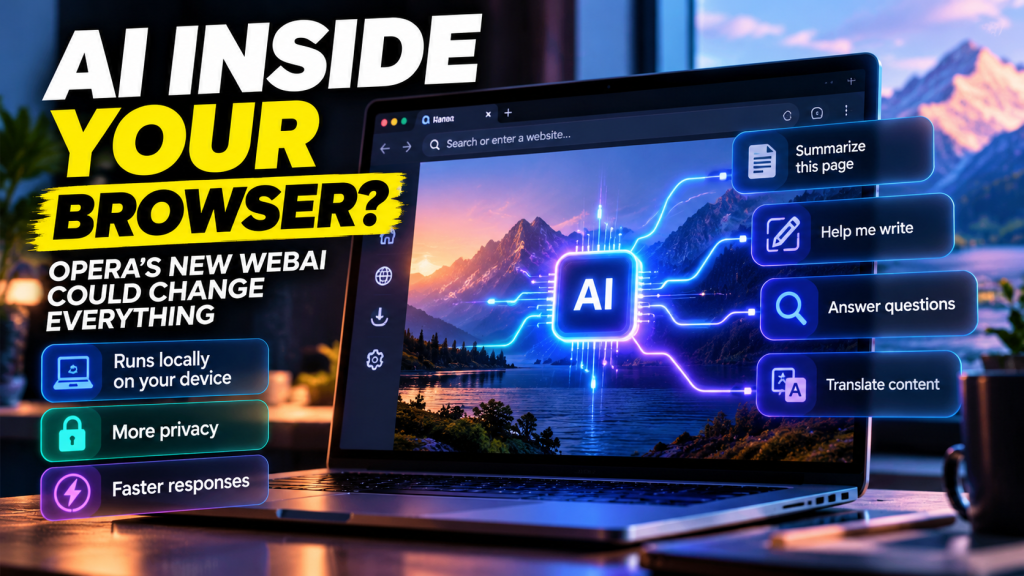
WebAI is designed to help websites work with AI models running on a user’s own device.
According to reporting by TechCrunch, the proposed standard isn’t restricted to one AI provider. Opera says it is intended to support different models, including open-weight options such as Google’s Gemma.
On supported Macs, the approach can also work with Apple’s on-device foundation model.
The idea is to give web developers another way to build AI-powered features without depending entirely on a remote model for every request.
Why Running AI Locally Matters
Today, many AI services send requests to cloud-based servers. That approach makes powerful models widely accessible, but it also creates dependencies on network connections, service availability, and provider infrastructure.
Local AI takes a different route.
When a suitable model runs on the device, some tasks may be handled without sending the same information to a remote AI service. That could offer advantages for privacy, responsiveness, and certain offline experiences.
There are trade-offs, though. Local models need computing resources, and their performance depends heavily on the device and model being used.
A browser-based approach won’t automatically make every laptop capable of running the most demanding AI systems.
What Could This Mean for Everyday Users?
Imagine opening a website and using built-in AI assistance for summarizing text, organizing information, or working with documents.
Instead of every website building its own connection to a separate cloud AI service, developers could potentially use compatible local models through the browser.
That might make some AI features easier to integrate into ordinary websites.
However, these are possible applications, not a promise that every feature will be available immediately.
Is WebAI Available Everywhere?
Not yet.
Opera’s announcement concerns a new standard and the technology supporting it. Broader adoption will depend on developer interest, browser support, compatible devices, and how well the approach works in practice.
It’s also too early to know whether other major browsers will adopt the same approach.
The Bigger Picture
AI is gradually moving beyond standalone chatbots.
We’re seeing AI appear in writing apps, video editors, search tools, and operating systems. Browsers are another natural place for these features to develop.
Opera’s WebAI proposal is worth watching because it points toward a future where at least some AI experiences happen directly on the user’s device.
Whether it becomes a widely adopted standard remains an open question.
Source: TechCrunch, October 27, 2026 — Opera introduces a new web standard to let users deploy AI locally in their browser.
Radavora’s perspective: The most interesting part of this announcement isn’t another chatbot feature. It’s the possibility that websites could eventually offer useful AI tools with less reliance on cloud services.