
October 27, 2026
Apple’s latest Mac announcement isn’t just about making computers faster. It’s also about making them better at handling artificial intelligence.
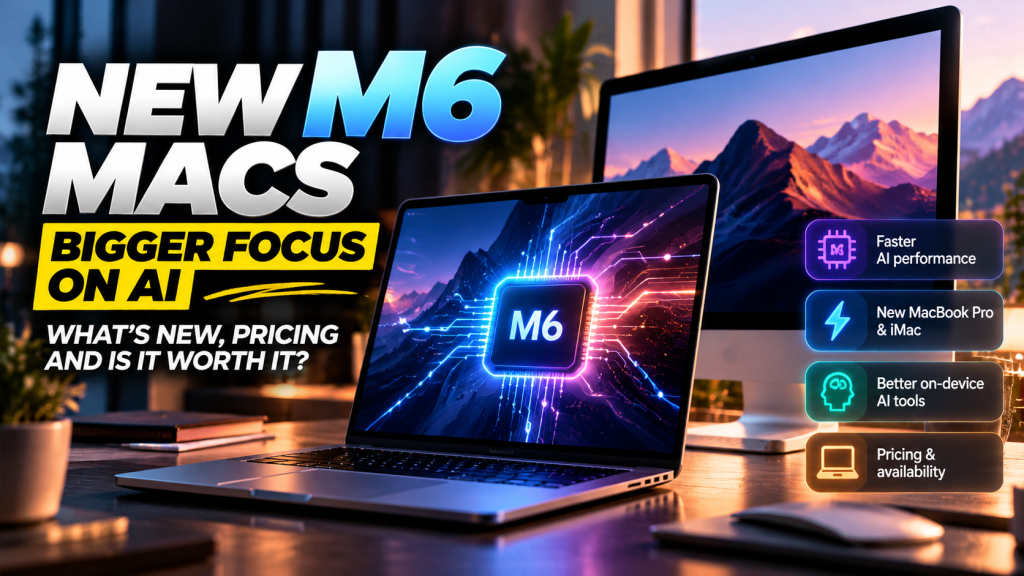
On Tuesday, Apple unveiled a new 14-inch MacBook Pro and iMac powered by its M6 chip. The company is highlighting improvements in on-device AI performance as part of the upgrade.
For people who use AI tools regularly, that focus is becoming increasingly relevant.
What’s New?
According to Reuters, Apple introduced two updated computers:
- A 14-inch MacBook Pro starting at $1,999.
- A new iMac starting at $1,499.
Both use Apple’s M6 chip, which the company says improves performance for AI tasks running directly on the computer.
Pre-orders are scheduled to begin on October 28 in 35 countries and regions, with availability starting November 6.
Why Is Apple Focusing on On-Device AI?
Many popular AI tools depend on cloud servers to process requests.
But some AI workloads can also run locally, using the computer’s own hardware.
That distinction matters because local processing can reduce dependence on an internet connection for supported tasks and may help keep certain information on the device.
It also creates opportunities for software developers to build AI-powered experiences that feel more integrated into everyday applications.
Of course, running AI locally doesn’t automatically mean every task will be faster or more private. Results depend on the application, model, and how the software handles data.
What Does This Mean for AI Creators?
People who work with AI-generated images, audio, video, or coding assistants are increasingly interested in how much work their own computers can handle.
More capable local hardware could eventually help with tasks such as:
- Processing audio and speech with compatible AI software.
- Running smaller AI models locally.
- Using AI-assisted features in creative applications.
- Working with AI tools that don’t require every operation to happen in the cloud.
These are potential benefits of stronger on-device AI hardware, not independently verified performance results for the new M6 Macs.
Specific applications will need testing before buyers can know how large the improvements are.
Should You Upgrade for AI?
Not necessarily.
If your current computer already handles the AI services you use, a new processor alone may not justify an upgrade.
Many popular AI tools still do their most demanding processing in the cloud, meaning your internet connection, subscription plan, and software workflow can matter more than your laptop’s chip.
The M6 announcement is more interesting as a sign of where personal computing is heading.
Apple is continuing to position local AI processing as an important part of the Mac experience.
The Bigger Picture
AI is becoming a regular consideration in computer hardware, not just an optional software feature.
For buyers, the useful question isn’t simply whether a laptop has an AI-capable processor. It’s whether the applications they actually use can take advantage of it.
That will be the real test for Apple’s new M6 machines.
Source: Reuters, October 27, 2026 — Apple launches M6 MacBook Pro and iMac, pitches faster on-device AI.
Radavora’s perspective: Better AI hardware is promising, but software support and real-world performance matter more than marketing claims. We’d wait for independent benchmarks before upgrading specifically for AI.