Updated October 28, 2026 | Comparisons | AI Voice & Video Tools
Affiliate disclosure: This article contains affiliate links. If you sign up or make a purchase through them, Radavora may earn a commission at no extra cost to you. Our recommendations are based on the tools’ capabilities and intended use cases, not commission rates.
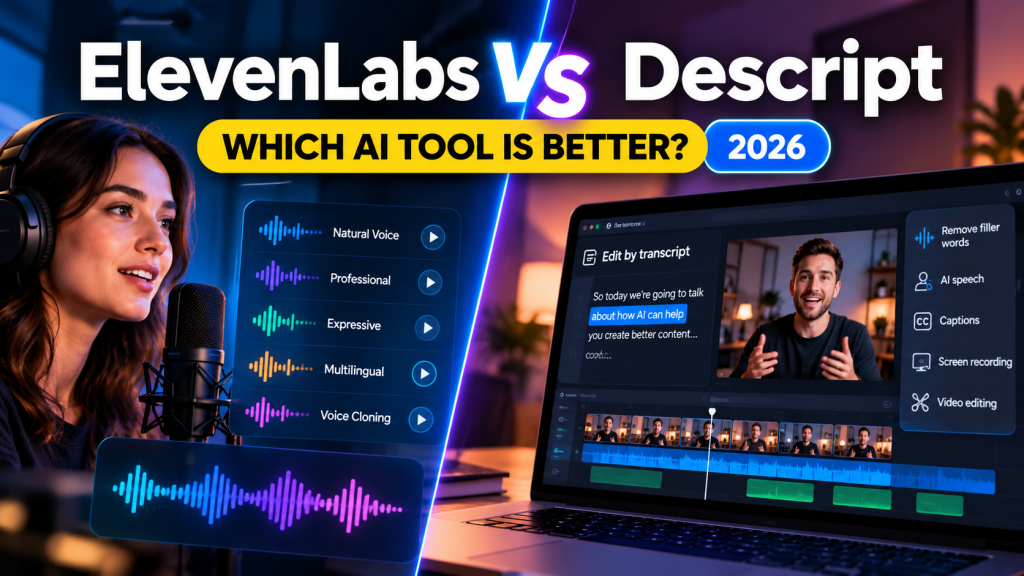
ElevenLabs vs Descript: which one should you choose? The answer depends less on which platform has the longer feature list and more on what you actually need to create.
If you want to turn a script into a convincing voiceover, ElevenLabs is the more natural starting point. If you have a recorded video, podcast, or interview that needs editing, Descript is likely to save you more time.
The distinction matters because both platforms now offer more than their original core features. ElevenLabs has expanded into audio and video production, while Descript includes AI-generated speech alongside its editing tools. They overlap, but they are not interchangeable.
In this comparison, we’ll look at their strengths, limitations, pricing, and the workflows where each makes the most sense.
Quick Verdict: ElevenLabs vs Descript
Choose ElevenLabs if:
- You primarily need AI-generated narration or voiceovers.
- You want to experiment with different voices, accents, and delivery styles.
- Voice cloning or multilingual speech is central to your project.
- You’re producing audio from scripts rather than editing existing recordings.
Choose Descript if:
- You edit podcasts, interviews, tutorials, or YouTube videos.
- You want to edit recordings by changing their transcripts.
- You frequently remove filler words, clean up dialogue, or create short clips.
- You need a single workspace for recording, editing, captions, and exporting.
Our recommendation: For dedicated AI voice generation, start with ElevenLabs. For editing spoken-word video and audio, start with Descript. If you regularly create narrated videos, the two can complement each other.
Explore the tools:
ElevenLabs vs Descript: At a Glance
| Feature | ElevenLabs | Descript |
|---|---|---|
| Primary strength | AI voice and speech generation | AI-assisted audio and video editing |
| Text-to-speech | Core capability | Available |
| Voice cloning | Instant and professional options, depending on plan | Custom voice cloning |
| Text-based editing | Some editing capabilities in Studio | Central editing workflow |
| Video editing | Available through Studio | Core product |
| Podcast editing | Useful for generating or improving audio | Especially suited to recorded conversations |
| Audio cleanup | Voice isolation and related tools | Studio Sound and editing tools |
| Captions | Available in Studio | Built into video workflows |
| Multilingual workflows | Speech generation and dubbing | Translation and dubbing tools |
| Best fit | Narration-first creators | Recording- and editing-first creators |
| Free option | Yes | Yes |
Features and limits vary by subscription. Pricing and plan details can change.
1. AI Voice Quality and Text-to-Speech
This is the most important category if you’re choosing a tool for narration.
ElevenLabs: Built Around the Voice
ElevenLabs specializes in generating speech from text. You can choose from a large voice library, create custom voices, and use different speech models depending on whether you prioritize expression, speed, or consistency.
That makes it attractive for projects such as YouTube narration, audiobooks, training materials, character dialogue, and product explainers.
A practical advantage is the ability to work on the voice itself: how a line is delivered, whether the chosen voice fits the audience, and how naturally the narration flows across longer passages.
The trade-off is that AI narration still needs direction. Names can be mispronounced, pauses may need adjustment, and an expressive voice isn’t automatically the right voice for every brand.
Descript: Voice Generation Inside an Editing Workflow
Descript also supports text-to-speech and custom AI voices. Its advantage is context: generated speech sits alongside tools for editing the rest of your recording.
Imagine recording a tutorial and discovering that one sentence contains the wrong product name. Instead of rebuilding the entire project, you may be able to correct or regenerate the relevant audio within your editing workflow, subject to the tool’s capabilities and plan limits.
That is a different problem from generating a ten-minute narration from scratch.
Winner for dedicated AI narration: ElevenLabs.
Descript remains useful for speech generation, especially when the voice is one part of a larger editing project.
2. Video Editing and Podcast Production
This is where the balance shifts.
Descript: Edit the Words, Not Just the Timeline
Descript’s defining feature is transcript-based editing. Rather than searching through a timeline for every mistake, you can work with the words in a recording.
Delete an unwanted sentence from the transcript, and Descript can remove the corresponding section from the media. Its AI tools can also help with filler words, audio cleanup, captions, and repurposing longer recordings into clips.
For interview-heavy content, that approach can make editing feel more approachable.
It’s particularly relevant for:
- Podcasts with multiple speakers.
- Talking-head YouTube videos.
- Webinars and online courses.
- Customer interviews.
- Short clips taken from longer recordings.
There is still a learning curve. Transcript edits can create awkward transitions, and automatic cuts should be reviewed rather than accepted blindly. More complicated visual projects may also require a different editing approach.
ElevenLabs: Production Tools Beyond Speech
ElevenLabs is no longer limited to generating voice files. Its Studio product supports audio and video timelines, captions, sound effects, and other production features.
That expansion makes it more useful for creators who want to assemble narrated content without moving between as many tools.
Even so, if your starting point is a recorded interview full of retakes, pauses, and filler words, Descript’s transcript-first workflow remains the clearer fit.
Winner for podcast and talking-head video editing: Descript.
3. Voice Cloning: Which Tool Makes More Sense?
Both platforms offer voice cloning, but the right choice depends on why you’re cloning a voice.
ElevenLabs provides instant voice cloning and, on eligible plans, professional voice cloning. This makes it a compelling option for creators who want a reusable voice identity for narration across multiple projects.
Descript’s custom AI voices fit naturally into recording and editing workflows. They can be helpful when you need to create speech or repair a section without recording an entirely new take.
Neither tool should be treated as a shortcut around consent. Only clone a voice you own or have clear permission to use, and check the platform’s current policies and commercial-use terms.
Our take: ElevenLabs is the stronger starting point when building a synthetic narration voice is the main goal. Descript is worth considering when voice generation mainly supports editing existing content.
4. Audio Cleanup, Captions, and Everyday Workflow
Good audio isn’t only about generating a natural voice. Sometimes the bigger problem is the recording you already have.
Descript’s Studio Sound is designed to improve spoken audio, while tools such as filler-word removal and transcript editing help streamline the cleanup process.
ElevenLabs also offers voice isolation and audio-production tools, which can be useful when cleaning up dialogue or preparing audio for a larger project.
The key question is what happens after cleanup.
If you’re preparing a finished video with captions and cuts, Descript keeps those tasks together. If you’re primarily preparing polished narration for use elsewhere, ElevenLabs may be the simpler route.
Winner for an all-in-one spoken-video workflow: Descript.
5. ElevenLabs vs Descript Pricing in 2026
The two platforms charge for different kinds of usage, so comparing only the monthly subscription price can be misleading.
ElevenLabs Pricing
ElevenLabs’ published monthly plans include:
| Plan | Listed monthly price |
|---|---|
| Free | $0 |
| Starter | $6 |
| Creator | $22 |
| Pro | $99 |
Higher-volume business plans are also available.
ElevenLabs uses a credit-based system. Your actual usage depends on the features and models you choose, and generating or regenerating audio can consume credits.
Commercial-use rights and some cloning features depend on the plan.
Descript Pricing
Descript’s published prices include:
| Plan | Monthly billing | Annual billing equivalent |
|---|---|---|
| Free | $0 | $0 |
| Hobbyist | $24/month | $16/month |
| Creator | $35/month | $24/month |
| Business | $65/month | $50/month |
Descript plans combine media-hour allowances with AI credits and feature access. That matters if you import long recordings or frequently use AI-powered editing tools.
Which Is Better Value?
If you only need to generate voiceovers, ElevenLabs’ lower-priced plans may be the more economical starting point.
If you regularly edit recorded content, Descript can replace several separate steps in your workflow. In that situation, the value comes from the editing time it may save—not just the amount of AI-generated speech included.
Before subscribing, estimate a typical month of work:
- How many minutes of narration will you generate?
- How many hours of recorded footage will you import?
- How often will you regenerate lines or use AI editing tools?
- Do you need commercial rights, higher-quality exports, or team features?
Pricing note: Prices are in USD, exclude applicable taxes, and may change. Promotional offers, annual discounts, credits, and feature limits should be checked on the official pricing pages before purchase.
Check current plans:
6. Ease of Use: Which Is Better for Beginners?
Neither platform is difficult in exactly the same way.
ElevenLabs is straightforward when the task is simple: paste a script, choose a voice, generate audio, listen, and revise. Beginners can reach a usable result without learning traditional audio-editing software.
But getting consistently good narration takes experimentation. Voice choice, script punctuation, pronunciation, and pacing can all affect the result.
Descript is approachable for people who think in sentences rather than editing timelines. Seeing the recording as text makes it easier to understand what should be cut.
However, Descript offers more of an end-to-end production environment. Beginners still need to learn scenes, layouts, captions, exports, and other editing decisions.
Easier for first-time AI voice generation: ElevenLabs.
Easier for transcript-based editing: Descript.
7. Pros and Cons
ElevenLabs Pros
- Strong focus on natural-sounding AI speech.
- Extensive voice choices and customization options.
- Voice cloning and multilingual capabilities.
- Useful for narration-first workflows.
- Free plan for initial experimentation.
ElevenLabs Cons
- Credits can be consumed quickly when repeatedly regenerating audio.
- Voiceovers may still need manual pronunciation and pacing adjustments.
- It may not replace a dedicated video editor for complex projects.
- Commercial rights and advanced features depend on the plan.
Descript Pros
- Edit recorded speech through its transcript.
- Combines audio, video, captions, and AI tools.
- Useful for podcasts, interviews, and talking-head videos.
- Audio cleanup and filler-word tools reduce repetitive work.
- Supports AI speech within the editing process.
Descript Cons
- More features mean more to learn.
- Media-hour and AI-credit limits require attention.
- Automated edits still need human review.
- Not every advanced video-editing task fits a transcript-first workflow.
8. Real-World Scenarios: Which Should You Pick?
Scenario A: A Faceless YouTube Channel
You write scripts and need engaging narration for videos without recording your own voice.
Start with ElevenLabs. The voiceover is the central task. You can then bring the audio into whichever video editor you prefer.
Scenario B: A Weekly Interview Podcast
You record 45-minute conversations and spend hours cutting mistakes, pauses, and tangents.
Start with Descript. Transcript-based editing and audio cleanup address the work consuming most of your time.
Scenario C: Online Courses and Training Videos
You produce screen recordings and frequently need to update instructions when software interfaces change.
Consider Descript first if you’re editing existing recordings. Consider ElevenLabs if you’re producing narration from prepared scripts.
Scenario D: Multilingual Narration
You want versions of the same script in multiple languages and care about consistent voice presentation.
Consider ElevenLabs first. Check support for your target languages and test pronunciation before committing to a paid workflow.
Scenario E: Repurposing Long Videos Into Shorts
You record webinars or interviews and want shorter social clips with captions.
Start with Descript. This is closer to its core editing and repurposing workflow.
9. Can You Use ElevenLabs and Descript Together?
Yes—and for some creators, that may be the most practical answer.
A combined workflow could look like this:
- Write and revise your narration script.
- Generate the voiceover in ElevenLabs.
- Import the audio into Descript.
- Add video footage, screen recordings, or supporting visuals.
- Refine the edit, add captions, and export.
The benefit is specialization: use one tool for generating the voice and the other for assembling the finished content.
The downside is cost and complexity. Paying for both only makes sense if you genuinely use both sets of features.
For a new creator on a tight budget, start with the tool that solves your biggest immediate problem. Add the second only when the workflow demands it.
Final Verdict: ElevenLabs or Descript?
There isn’t a universal winner in the ElevenLabs vs Descript comparison.
ElevenLabs is our pick for creators whose priority is generating AI speech. It is especially appealing for scripted narration, voice experimentation, and projects where the synthetic voice itself is the main product.
Descript is our pick for creators who need to edit recorded speech and video. Its transcript-based approach makes sense for podcasts, interviews, tutorials, and content repurposing.
The simplest way to decide is to ask yourself one question:
Am I mainly creating a voice, or editing a recording?
If you’re creating a voice, begin with ElevenLabs. If you’re editing a recording, begin with Descript.
Try the Tool That Fits Your Workflow
For AI voiceovers and narration: Try ElevenLabs
For podcast and video editing: Try Descript
Both offer a way to explore their products before committing to a paid subscription.
Frequently Asked Questions
Is ElevenLabs better than Descript?
ElevenLabs is generally the better starting point for dedicated AI voice generation. Descript is generally the better starting point for editing recorded podcasts and videos. The right choice depends on your workflow.
Can Descript generate AI voices?
Yes. Descript includes AI speech generation and custom voice cloning, with access and limits depending on the plan.
Can ElevenLabs edit videos?
Yes. ElevenLabs Studio includes video-related editing and production features. However, Descript’s transcript-based editing remains particularly relevant for creators working with recorded conversations and tutorials.
Which tool is better for YouTube?
Choose ElevenLabs if you need narration for scripted or faceless videos. Choose Descript if you record yourself, edit interviews, or turn long videos into shorter clips.
Which is cheaper, ElevenLabs or Descript?
ElevenLabs has a lower-priced entry-level paid plan based on the published monthly rates reviewed for this article. But the better value depends on how much audio you generate or recorded media you edit.
Do I need both ElevenLabs and Descript?
No. Many creators will be better off starting with one. Using both makes sense when you need specialized AI narration and transcript-based video editing in the same workflow.
Editorial note: This comparison is based on published product documentation, features, pricing, and workflow analysis as of October 28, 2026. It is not presented as a hands-on laboratory test. Features, limits, and prices may change.
Sources: ElevenLabs Pricing · ElevenLabs Text-to-Speech Documentation · ElevenLabs Studio · Descript Pricing and Features