AI-generated illustration.
China’s humanoid robotics industry is entering a new phase. After years of attention-grabbing demonstrations, companies are investing heavily in artificial intelligence that could help robots understand unfamiliar environments and complete useful tasks without being programmed for every movement.
The shift is creating a fast-growing market for embodied AI, a form of artificial intelligence designed to interact with the physical world.
According to a Reuters report published on November 2, Chinese embodied AI companies attracted approximately 93.5 billion yuan ($13 billion) across 322 investment deals during the first half of 2026. That was roughly five times the funding recorded in the same period a year earlier, based on data from research firm ITjuzi.
The investment surge suggests that the industry’s next major challenge is no longer simply building machines that can walk or balance. It is developing software that makes those machines useful in real workplaces.
Why China Is Shifting From Robot Hardware to AI Intelligence
Humanoid robots have become increasingly capable of complex physical movements.
Demonstrations of running, dancing and other coordinated actions show how far robotic hardware and motion control have advanced.
But performing a rehearsed routine is different from completing an unpredictable task in a factory, warehouse or home.
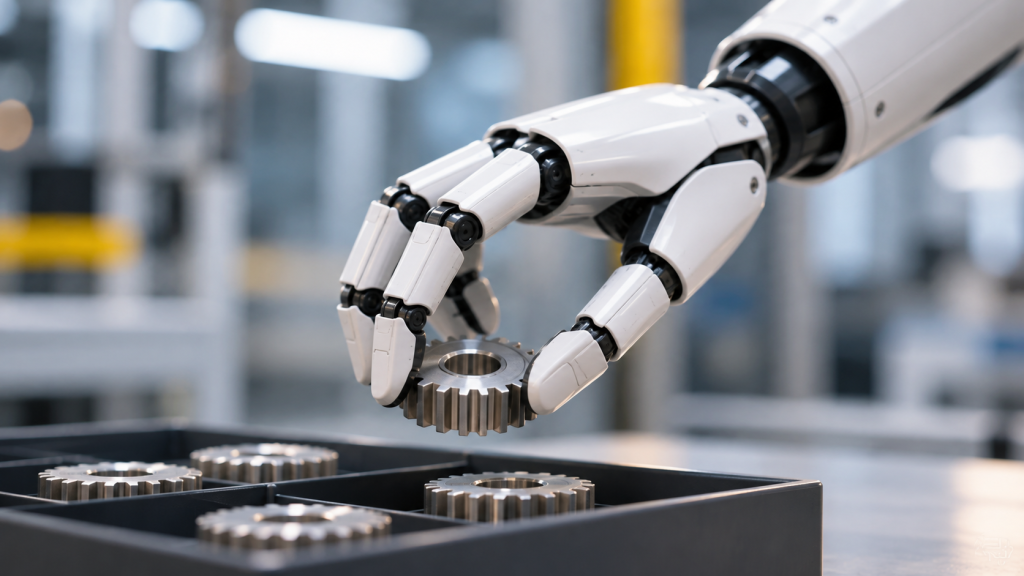
A useful robot may need to identify an unfamiliar object, decide how to pick it up, respond when something moves and recover when an action fails.
Those abilities depend on perception, reasoning, learning and physical control working together.
This is where embodied AI becomes important.
As robot hardware becomes more competitive, developers are increasingly looking to intelligent software as a way to differentiate their products.
The commercial opportunity is substantial: a robot that can learn new tasks could potentially be deployed across more workplaces without extensive custom programming.
However, that possibility has not yet translated into broadly reliable general-purpose robots.
What Is Embodied AI?
Embodied AI is artificial intelligence that learns to perceive, decide and act within a physical environment.
Traditional AI assistants primarily work with digital information, including text, images and software.
Embodied AI connects intelligence to physical machines.
For example, a robot working in a warehouse might need to:
- Recognize objects of different sizes and shapes
- Understand which item a worker wants
- Choose an appropriate grip
- Move safely around people and equipment
- Adjust when an object slips or is moved
- Complete the task without constant human intervention
The difficulty is that physical environments are far less predictable than a controlled software interface.
Objects have weight, friction and flexibility. Cameras can lose sight of important details. A small positioning error can cause an otherwise simple task to fail.
These challenges help explain why impressive demonstrations do not automatically lead to dependable commercial products.
China’s Embodied AI Investment Reaches $13 Billion
The scale of investment is one of the most significant developments in the Reuters report.
Citing ITjuzi data, Reuters reported that Chinese embodied AI companies raised 93.5 billion yuan in the first six months of 2026, spread across 322 deals.
The reported funding was approximately five times the level recorded a year earlier.
That capital is reaching companies developing robot intelligence, not just manufacturers building the physical machines.
Chinese startups including X Square, Galaxea and Spirit AI are among the businesses competing to develop more capable robot software.
The investment boom reflects growing interest in systems that could eventually support manufacturing, logistics and other labor-intensive activities.
But investment does not prove commercial success.
Robotics companies still need to demonstrate that their systems can operate consistently, economically and safely outside carefully managed testing environments.
How Are Companies Teaching Robots New Skills?
One of the biggest obstacles to intelligent robotics is training data.
Language models can learn patterns from enormous collections of digital text.
Robots also need examples of physical interactions: how objects move, how much force to apply and what happens when a task goes wrong.
Companies are experimenting with several approaches.
Learning From Human Demonstrations
Some developers collect recordings of people performing physical tasks.
These demonstrations can help AI models learn relationships between observations, movements and successful outcomes.
Reuters reported that Spirit AI has employed approximately 1,000 people to record everyday and industrial activities.
Other companies use wearable sensors to capture movements and physical forces during work.
The aim is to give robots examples of how tasks are performed in the real world.
Training Across Different Robots
Another challenge is making an AI model useful on more than one machine.
Different robots have different arms, joints, sensors and movement capabilities.
According to Reuters, Ant Group’s robotics division, Robbyant, trained software using data covering 20 robot configurations from 17 brands.
That approach could help developers build intelligence that transfers between machines, although broad compatibility remains a technical challenge.
Using Simulations
Virtual environments allow developers to test robot behavior without physically repeating every experiment.
Simulations can reduce costs and accelerate training.
However, they cannot perfectly reproduce the complexity of real-world contact, movement and material behavior.
A robot that performs well in simulation may still struggle when confronted with unexpected objects or conditions.
Where Are Humanoid Robots Already Being Used?
Despite the remaining challenges, some Chinese companies are testing AI-enabled robots in practical settings.
Reuters reported that battery manufacturer CATL uses Spirit AI robots to connect flexible wires during battery-pack testing at its Zhongzhou facility.
CATL reported a success rate above 99% for the insertion task.
Meanwhile, Robbyant said its robots process orders at two pharmacies in Shanghai, with employees checking medicines before dispatch.
These examples are important because they involve identifiable workplace tasks rather than entertainment demonstrations.
However, they also illustrate a limitation.
Success at a specific, carefully defined task does not mean a robot can independently handle an entire workplace.
A factory process may involve controlled equipment, predictable object locations and specialized training.
A general-purpose robot must cope with a much wider range of situations.
China and the US Are Competing to Build Robot Intelligence
The development of embodied AI is also becoming part of the wider technology competition between China and the United States.
American startups such as Physical Intelligence, Skild AI and Generalist are developing AI systems intended to teach robots new capabilities with less task-specific programming.
Chinese companies have their own advantages.
China’s extensive manufacturing base gives developers opportunities to work closely with hardware suppliers and industrial customers.
That can make it easier to collect physical training data and test systems in production environments.
US developers, meanwhile, benefit from strengths in advanced AI research and access to powerful computing resources.
Neither advantage guarantees leadership.
The companies that succeed will need to combine capable models, reliable hardware, useful training data and economically viable deployment.
Advanced AI Chips Remain a Major Challenge
Training sophisticated robot AI systems requires computing power.
That creates an additional challenge for Chinese developers facing restrictions on access to some advanced US-designed chips.
Reuters reported that industry participants see the availability of high-performance processors as a potential constraint as embodied AI models become more demanding.
Chinese companies are responding by exploring more efficient models, simulated training data and domestic chip alternatives.
But it remains uncertain how effectively those approaches can compensate for restrictions on advanced computing hardware.
This is another reason why the industry’s progress cannot be measured by investment figures alone.
Will Humanoid Robots Have Their Own ChatGPT Moment?
The robotics industry is searching for a breakthrough that could make intelligent machines substantially more useful.
Reuters reported that Unitree founder Wang Xingxing discussed the possibility of a major leap in robotic capabilities as AI models improve.
The comparison is understandable.
ChatGPT made conversational AI accessible to a much wider audience. Robotics companies hope for a similarly significant improvement in machines that can perform physical tasks.
But there is an important difference.
A chatbot can generate an imperfect response without physically damaging an object or endangering someone nearby.
A robot operating around people and machinery needs a much higher degree of reliability.
Even if a future AI model performs a wide variety of tasks in demonstrations, businesses will still need evidence that it can repeat those tasks safely over long periods.
For that reason, a breakthrough in robot intelligence may arrive before widespread commercial adoption.
What Does This Mean for Businesses and Workers?
More capable robots could eventually change how companies approach repetitive or physically demanding work.
Potential applications include manufacturing, logistics, inspection and certain service tasks.
But the near-term impact is likely to depend on how reliably robots perform specific jobs and whether their total cost makes economic sense.
Businesses considering robotic automation should look beyond demonstration videos.
Useful questions include:
- How often does the robot complete the task successfully?
- How does it respond to unexpected situations?
- Does it require continuous human supervision?
- How expensive is deployment and maintenance?
- Can the system learn new tasks without major reprogramming?
- What safety controls are required?
These questions matter more than whether a robot can perform a spectacular movement.
For workers, the effects will depend on the industry, the tasks automated and how employers introduce the technology. The current evidence does not support assuming that general-purpose humanoids are ready to replace entire job roles.
Why This Matters Beyond Robotics
The shift toward embodied AI illustrates a broader change in artificial intelligence.
For years, much of the public discussion has focused on models that generate text, images, code and other digital content.
Robotics introduces a different challenge: turning AI-generated decisions into dependable physical actions.
For readers interested in the differences between today’s leading digital AI assistants, Radavora’s ChatGPT vs Claude comparison explores their capabilities and practical uses.
However, a strong conversational AI model is not automatically a capable robot controller.
Physical intelligence requires additional abilities, including spatial understanding, motion planning and feedback from the real world.
What Happens Next?
The next stage of China’s humanoid robot industry will be measured less by publicity demonstrations and more by repeatable results.
Key developments to watch include improvements in general-purpose robot models, larger collections of physical training data and independently demonstrated performance across different workplaces.
Another important indicator will be whether robots can complete unfamiliar tasks without lengthy retraining.
For now, the technology is advancing, but its commercial potential remains partly unproven.
Final Takeaway
China’s humanoid robot makers have demonstrated impressive progress in hardware and movement.
Now the industry is directing substantial investment toward the intelligence required to make robots useful.
The reported $13 billion funding surge in the first half of 2026 shows the scale of interest in embodied AI.
But the central challenge remains unchanged: a robot must do more than move convincingly. It must understand its surroundings, adapt to problems and complete real tasks reliably.
That is the competition likely to shape the next phase of robotics.
Sources and Editorial Notes
Primary reporting: Reuters — China’s Robot Makers Have Mastered the Moves. Now Comes the Race for Brains (November 2, 2026)
Additional context: Reuters — This Robot Can Stock a Fridge. Is It Ready for Your Home? (October 29, 2026)
This article is an original Radavora news report and analysis based on attributed reporting and publicly described robotics developments. Company-reported performance figures are identified as such and have not been independently verified by Radavora. The article contains no affiliate links.