Published November 8, 2026
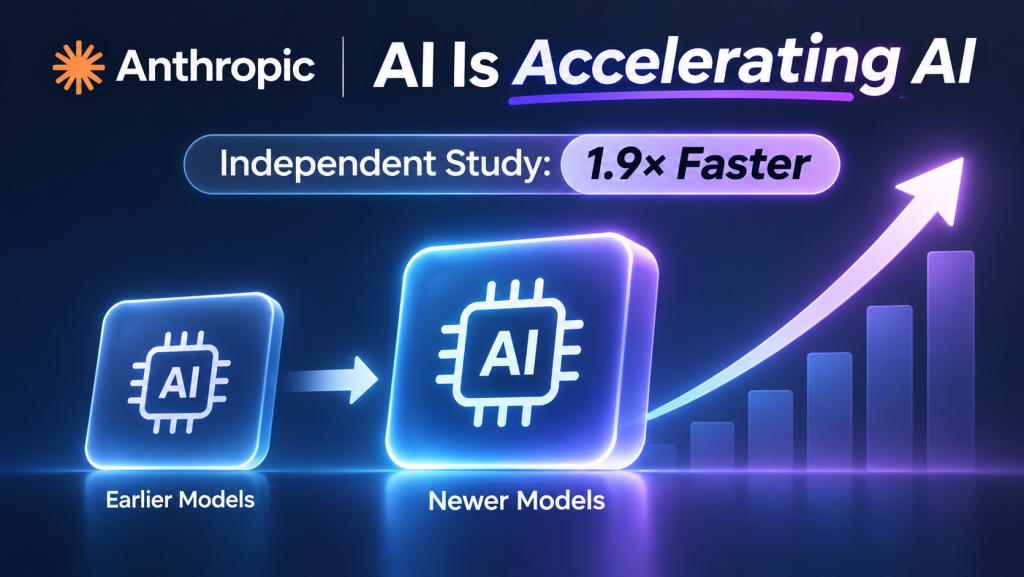
Anthropic’s artificial intelligence models are improving at nearly twice their previous rate, according to a new independent study that suggests AI is increasingly helping researchers develop more capable AI systems.
The assessment, published by nonprofit research organization METR on November 5, 2026, found that Anthropic’s progress on measured AI capabilities has accelerated by approximately 1.9 times since October 2025.
Researchers believe much of the acceleration is linked to Anthropic’s growing use of AI in its own research and development.
The findings raise an important question: Could AI begin improving itself faster than humans can evaluate its risks?
What Did the METR Study Find?
METR, short for Model Evaluation and Threat Research, conducted an independent assessment of Anthropic’s internal AI development process.
Between August 12 and October 29, 2026, researchers examined internal performance data, development metrics and interviews with Anthropic employees.
Their main findings were:
- 1.9× faster progress: Anthropic’s benchmark capabilities improved at approximately 1.9 times their previous rate.
- AI-assisted research: Researchers believe AI contributed to a majority of the observed acceleration.
- Not simply more computing power: METR found that faster growth in training compute did not explain the change.
- Potential for further acceleration: Researchers did not identify a clear near-term bottleneck that would necessarily stop continued rapid progress.
The researchers estimated a 95% confidence interval of 1.5× to 2.8× for the measured acceleration.
However, they emphasized that the estimates remain uncertain and depend on how AI capabilities are measured.
AI Is Helping Build Better AI
One of the study’s most significant conclusions is that Anthropic increasingly uses its own AI systems to support AI development.
This includes helping researchers write code, conduct experiments and improve development workflows.
METR found evidence consistent with AI assistance contributing substantially to faster progress.
Reuters reported that researchers estimated AI might account for around 80% of the observed acceleration, although the estimate is uncertain.
This does not mean AI is independently creating new Claude models without human involvement.
METR specifically stated that AI systems are not yet making highly significant, fully autonomous contributions to the most important stages of model training.
Instead, the current acceleration appears to come primarily from AI making human researchers more productive.
What Does 1.9× Faster AI Development Actually Mean?
The figure describes the rate of progress on measured capabilities, not the speed of an individual Claude response.
METR estimates that Anthropic achieved roughly two years of its previous benchmark progress in about one year.
| Finding | METR assessment |
|---|---|
| Estimated acceleration | 1.9× |
| 95% confidence interval | 1.5×–2.8× |
| Main contributing factor | Increased AI assistance in research |
| Faster training-compute growth responsible? | No |
| Fully autonomous AI development achieved? | No |
The results apply to the capabilities and development processes examined in the study.
They do not establish that every Claude feature, real-world task or future AI model will improve at the same rate.
What Is Recursive Self-Improvement?
The findings have renewed interest in a concept called recursive self-improvement, or RSI.
Recursive self-improvement describes a process in which an AI system helps create a more capable successor, which can then contribute to further improvements.
In theory, this could produce a feedback loop:
- Researchers develop a more capable AI model.
- That model helps accelerate AI research.
- Faster research produces an even more capable model.
- The cycle repeats.
However, the METR study does not demonstrate that Anthropic has achieved fully autonomous recursive self-improvement.
It provides evidence that AI-assisted research is already accelerating development, while important stages of the process still depend on human researchers.
Why Are Researchers Concerned?
Faster AI development could bring substantial benefits.
More capable models may help researchers solve difficult problems in science, medicine and engineering.
But rapid progress could also make it harder to evaluate new systems before they are deployed.
If capabilities improve faster than safety testing, developers may have less time to identify emerging risks.
METR said it found no convincing evidence of major bottlenecks that would necessarily prevent further rapid progress over the next 12 months.
That is not a prediction that AI development will definitely accelerate again.
Rather, it means researchers could not confidently identify a constraint that would stop it.
Important Limitations of the Study
Although METR had unusual access to Anthropic’s internal research, several limitations matter.
First, much of the most informative evidence was redacted.
Anthropic restricted the publication of certain internal details, citing concerns about confidential information that could benefit competing AI developers.
METR acknowledged that these redactions make it difficult for outside readers to independently evaluate all the evidence.
Second, benchmark performance is not the same as real-world impact.
The study focused on measurable AI capabilities. Those results may not fully represent how useful or reliable models are across every practical task.
Third, the contribution of AI assistance remains uncertain.
Researchers found strong indications that AI played a major role, but they could not precisely separate every contributing factor.
These limitations do not invalidate the findings, but they are important when interpreting claims about AI improving itself.
What Does This Mean for Claude Users?
The study does not announce a new Claude model, subscription plan or feature.
For everyday Claude users, there is no immediate product change associated with the report.
However, the findings suggest that AI-assisted development could help companies such as Anthropic improve future models more quickly.
Whether that leads to better reasoning, coding performance, lower prices or more reliable everyday assistance remains to be seen.
Readers interested in the practical differences between today’s leading assistants can explore our ChatGPT vs Claude comparison.
Frequently Asked Questions
Is Anthropic developing AI twice as fast?
According to METR’s November 2026 assessment, Anthropic’s progress on certain measured AI capabilities has accelerated by approximately 1.9 times compared with its earlier pace.
Is Claude improving itself?
Anthropic uses AI to assist researchers developing new models. However, METR did not find that Claude or another Anthropic model is independently managing the most important stages of AI development.
What is METR?
METR is an independent nonprofit organization that studies advanced AI capabilities, evaluations and potential risks.
Does the study prove recursive self-improvement?
No. It provides evidence of AI-assisted acceleration, but not fully autonomous recursive self-improvement.
Will Anthropic release new models twice as often?
Not necessarily. The study measures capability progress, not product-release frequency. It does not establish a future release schedule.
Final Thoughts
The METR study suggests that AI is becoming an increasingly important tool for developing the next generation of AI systems.
Anthropic’s measured progress has accelerated substantially, and independent researchers believe AI assistance explains much of that change.
But the findings also come with significant uncertainty, including redacted evidence and limitations in the benchmarks used.
The most important conclusion is not that AI can already improve itself without humans.
It is that AI-assisted development may be accelerating fast enough to change how researchers, companies and regulators prepare for future advances.
Sources
- METR — Independent Assessment of AI R&D Acceleration at Anthropic in October 2026
- Reuters — Anthropic’s Models Improving Nearly Twice as Fast With Help From AI, Study Finds
- Associated Press — Anthropic Is Rapidly Accelerating AI Development, Outside Research Group Says
Editorial disclosure: This article is based on METR’s independent assessment published November 5, 2026, and reporting from Reuters and Associated Press. Radavora has not independently audited Anthropic’s internal development data. The study’s estimates are uncertain, and some supporting evidence was redacted.